


On the long road of fighting cancer, Ms. Li (pseudonym) admits that she was once a disobedient “deserter.” Yet somehow, this “deserter” was pulled back to the battlefield again and again—by her family, by her doctors, and by the small but persistent will to live that never truly faded.
Her story began 15 years ago.
Ms. Li comes from the grasslands of Inner Mongolia. That year, she went to a local hospital because of vaginal dryness and pain. The diagnosis—“cervical cancer”—hit her life like a bullet.
In fact, there had been warning signs. Back in 2009, she had experienced contact bleeding, but she did not take it seriously.
Radical surgery for cervical cancer, radiotherapy, chemotherapy… After a round of intensive treatments, she endured it all. The cancer cells actually retreated. For more than seven years, her follow-up reports were mostly clear. This meant she had passed the “five-year safety period,” which usually indicates a high chance of long-term survival.
Ms. Li thought so too.
Gradually, she let her guard down. Smoking, drinking, playing mahjong—in the smoke-filled card rooms, she felt no different from anyone else. Life, she believed, should be lived with warmth and vitality.
What she did not know was that cancer cells often strike when vigilance fades.
It was in 2017 when Ms. Li caught a cold and developed a persistent cough that would not go away. Her family felt something was wrong and urged her to see a doctor. The doctor studied her scans for a long time. After learning about her history of cervical cancer, he advised her to go to a larger hospital for further examination.
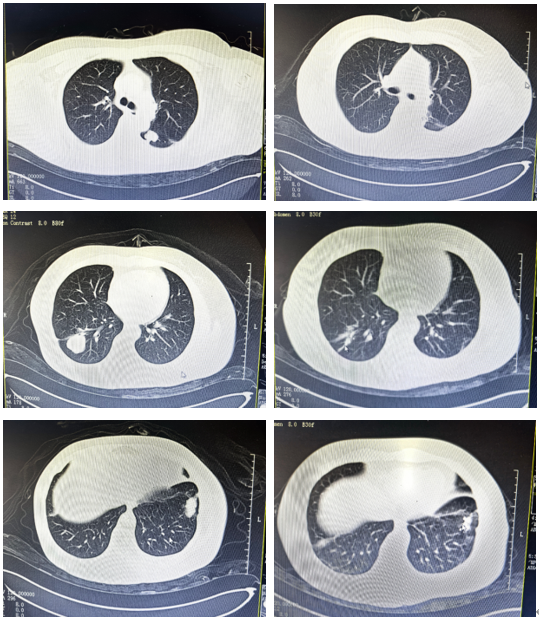
“The doctor said there were many shadows in my lungs—maybe seven or eight,” she recalled.
She traveled to Harbin and Tianjin, visiting hospitals in two cities. Both gave the same diagnosis: lung metastases from cervical squamous cell carcinoma.
At that moment, Ms. Li broke down in tears. She thought the battle had long been over. She thought seven years without problems meant a lifetime without problems. She thought… but the cancer cells thought otherwise.
The next three years were painful. Systemic chemotherapy brought nausea, vomiting, hair loss, and fatigue—none of it spared her. Even worse, while enduring the suffering, she watched the nodules on her follow-up scans grow larger and more numerous.
Eventually, drug resistance developed, and the cough became uncontrollable. Ms. Li herself felt that enduring day after day was almost like waiting for death.
But her daughter refused to give up. She believed that in such a big world, there had to be a better solution.
Through a friend in Changchun, she learned about a treatment called cryoablation. That friend had once traveled to Japan for the same treatment but was not satisfied with the results. After returning to China, he found President Dr. Niu Lizhi at Fuda Cancer Hospital in Guangzhou, underwent cryoablation again, and finally achieved a satisfactory outcome.
Hearing this, Ms. Li’s daughter felt a spark of hope—like seeing a faint light in the darkness.
In October 2021, Ms. Li traveled south to Guangzhou and arrived at Fuda. But deep inside, she was anxious. Her condition seemed so serious—could it still be treated?
“Multiple metastatic tumors in both lungs, close to the right lower pulmonary artery, adhesions with the interlobar pleura and chest wall pleura…”
Based on her condition, the medical team performed two sessions of cryoablation for lung metastases, along with needle biopsies. The biopsy results once again confirmed: metastases from the original cervical cancer.
After the procedures, Ms. Li continued with chemotherapy and immunotherapy. For more than a year afterward, her disease remained stable.
But once things stabilized, Ms. Li’s thoughts began to wander again.
“If it’s stable, isn’t that good enough? Maybe I don’t need further treatment.”
Then in January 2024, the tumors grew again.
Ms. Li returned to Fuda and underwent a third cryoablation procedure. However, there were too many nodules, and some continued to enlarge. She subsequently received three iodine-125 seed implantations, which finally reduced the tumors.
Just as her attending doctor suggested consolidating the treatment with interventional chemotherapy, Ms. Li’s “escape plan” resurfaced once more.
“I had seen other patients undergo interventional therapy before—the reactions looked severe… I was scared,” she said. This time, she truly wanted to give up. After so many cycles of treatment and recurrence, she was exhausted.
Then one day, Ms. Li received a call from her attending physician, Dr. Yang Ting.
The voice on the other end was as gentle and calm as always:
“Ms. Li, it’s time for your treatment. Please come back.”
Just that single sentence left her stunned for a long time.
Her family continued persuading her. At that moment, she thought about her young child and about how many patients in their seventies and eighties were still fighting. Why shouldn’t she keep going?
The interventional treatment turned out to be far less frightening than she had imagined—and the results surprised her.
The lung metastases shrank. The lymph nodes also shrank. Even the cough that had troubled her for years almost disappeared.
“Director Zhong Xiaojun from the interventional department knew I was very scared, so he chatted with me the whole time. Before I even realized it, the procedure was already done,” she said.
Fifteen years have passed. For Ms. Li, it feels like fighting three battles.
In the first battle, she won—and became careless.
In the second battle, she lost—and nearly gave up.
In the third battle, she is still fighting.
She once ran away from the battlefield, a “deserter” in her own words. But time and again, she was pulled back.
And this time, she finally sees the dawn of victory.

