


Unable to eat, sleep, or walk, she was burdened by a tumor that was massive, foul-smelling, ulcerated, and excruciatingly painful. Yet, when she and her family fell to their knees, begging doctors for admission, they were met with nothing but cold rejection.
Xiao He (pseudonym), a Hunan native under the age of 40, has been tormented by breast cancer for five agonizing years.
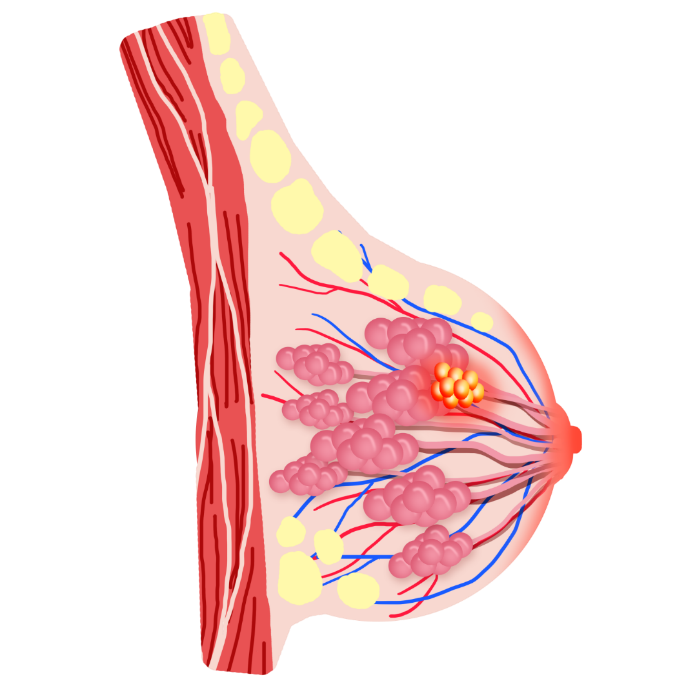
It All Began with a "Harmless" Nodule
It all started six years ago during a routine shower. She felt a lump in her breast and went to the county hospital for a check-up. The doctor assured her it was nothing to worry about—likely just a small nodule brought on by everyday stress and moodiness. However, this "harmless" nodule continued to grow. When the biopsy results finally came back, it was breast cancer.
She underwent six rounds of chemotherapy locally, which successfully shrank the tumor. Relieved, she decided against surgery and turned to traditional Chinese medicine (TCM) instead, firmly believing those who assured her it would cure her. But a little over a year later, the tumor roared back. This time, she underwent a radical mastectomy. Post-surgery, she continued taking oral TCM, having heard it would prevent a recurrence.
Unfortunately, the cancer returned anyway. It started as new growths in the surgical area accompanied by purulent discharge, and soon, her condition deteriorated drastically. A massive tumor, nearly 19 cm in size, tore through her left chest wall, invading the pectoralis major muscle and protruding visibly through her skin. Another 9 cm mass emerged on her left abdominal wall, and the cancer had already metastasized to her axillary lymph nodes and lungs.
Begging on Their Knees, Only to Be Told "Untreatable"
As Xiao He grew weaker by the day, even walking became impossible. Realizing that TCM alone could not save her, she went to local hospitals seeking help. However, because her tumor was so massive, ulcerated, and constantly leaking pus, she was repeatedly turned away. She and her family literally knelt to beg the doctors, only to be told, "Kneeling won't change anything. There's nothing we can do."
Later, she went to an emergency room where she received blood transfusions and albumin. Struggling to breathe and coughing relentlessly, no one came to check on her. The only response she received was a passing directive: "Just turn up her oxygen." That night, she looked at her husband and said, "No more treatment. If I'm going to die, I want to die at home."
Unwilling to give up, her family found a herbalist. They tried both oral remedies and topical poultices, but it only triggered diarrhea and severe rashes, making the pain from her ulcerated wounds unbearable. Just when they had reached a dead end, they learned about a couple next door who had both battled cancer. The wife, also a breast cancer survivor, had been receiving treatment at Guangzhou Fuda Cancer Hospital for several years and was doing remarkably well. Her family urged Xiao He to give it a try.
Exhausted physically and mentally by years of futile treatments, Xiao He resisted. She feared she wouldn't even survive the journey to Guangzhou. But her family insisted. After reaching out to Fuda's medical staff, whose patient and thorough communication offered a glimmer of hope, she finally relented with hesitation: "Alright, let's give it one last shot."
In March of this year, Xiao He, confined to a wheelchair, was wheeled into Medical Ward 6 at Fuda. Seeing that the hospital wasn't packed with the usual chaotic crowds, she couldn't help but feel skeptical: Is this place actually legitimate?
From Wheelchair-Bound to Riding a Motorcycle in a Few Cycles
Upon admission, Xiao He was in critical condition, suffering from anemia, hypoalbuminemia, severe edema in both lower limbs, massive pleural effusion, shortness of breath, and electrolyte imbalances. The ulcerated tumors on her left chest and abdominal walls were a horrific sight, leaking over 80 ml of foul-smelling fluid every day.
Using the Wound Assessment Triangle, Head Nurse Yin Wenjuan meticulously evaluated the injury: heavy exudate, severe malodor, and a high risk of bleeding. Recognizing that Xiao He's family could not afford the costly consumables for continuous negative pressure wound therapy (NPWT), the medical team brainstormed and custom-built a simple, cost-effective low-vacuum suction device for her.
Initially, Xiao He resisted the wound dressings. She cried out several times, "Stop wasting your time. Just let it rot. I'm going to die anyway." Instead of arguing, the nurse gently held her hand and said, "Let's just try it once today to make you more comfortable. If it doesn't help, we will stop."
That first dressing change took a grueling two hours. When it was finished, Xiao He felt an immense sense of physical relief. It was the first time she had ever encountered a nurse who dressed her wounds with such meticulous care and heartfelt encouragement.
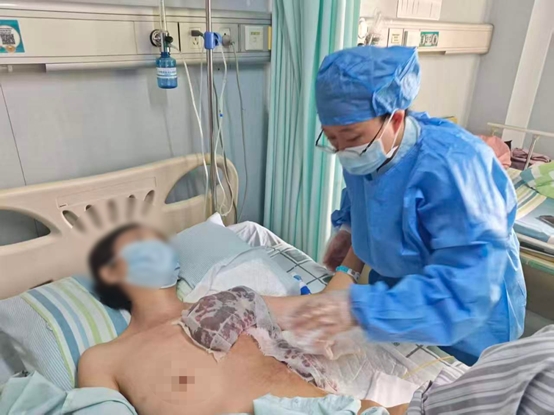
Concurrently, Director Li Hongmei's medical team initiated systemic supportive therapies to correct her low albumin levels and control the fluid buildup in her chest. A core needle biopsy of the chest wall mass confirmed triple-negative invasive ductal carcinoma (TNBC), with PD-L1 immunohistochemistry showing a Tumor Proportion Score (TPS)>10% and an Immune Cell Score (ICS) >10%.
Given her frail physical state, the team designed a customized regimen of interventional chemotherapy combined with embolization. This approach delivered chemotherapeutic agents directly into the tumor's local blood supply while using embolic agents to cut off its nutrient source, forcing the tumor into ischemic necrosis. This was paired with immunotherapy to mobilize her own immune system to recognize and attack the remaining cancer cells.
After just two cycles of treatment, Xiao He's CT scans revealed a dramatic shrinkage of the tumors and a significant reduction in pleural effusion. Today, the masses on her left chest and abdominal walls have completely vanished, and the ulcerated wound bed has shrunk remarkably. Once unable to even stand steady, she has now returned home and can comfortably ride her motorcycle around town.
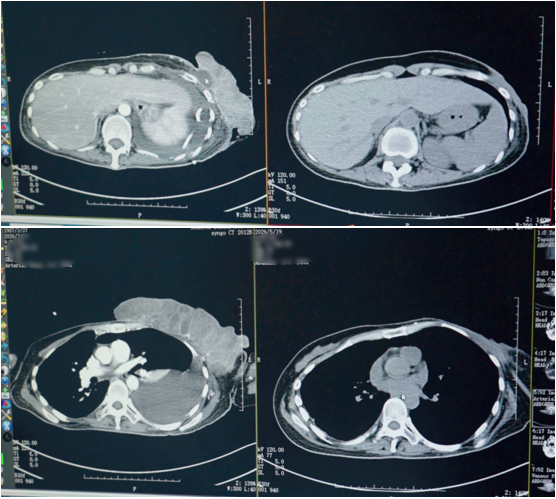
before and after treatment
"The doctors and nurses here treated me so well—they were incredibly patient, deeply caring, and never once looked at me with aversion," she shared. "Living with this disease was so excruciatingly painful, but I am so incredibly grateful that my family never let go of my hand. They practically forced me to come to Fuda, and that is what truly gave me a second lease on life."
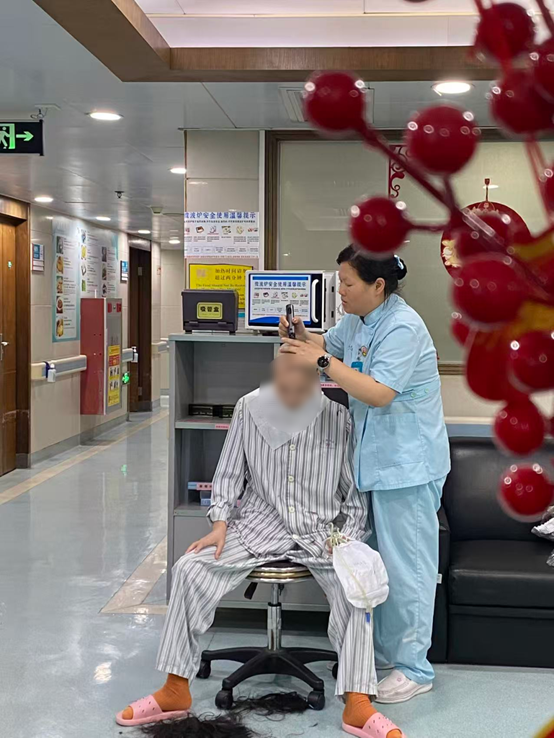
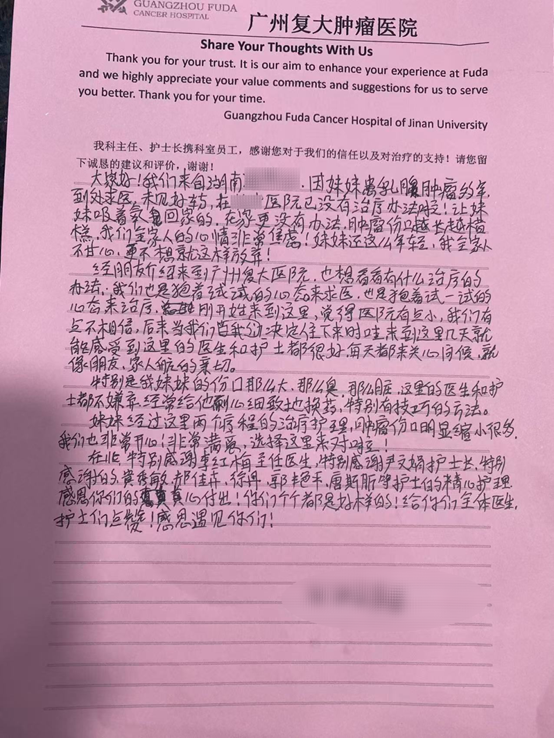
Five years of fighting cancer through endless relapses had nearly drained Xiao He of all her strength. But ultimately, in a hospital free of chaos and cold indifference, she found the most profound form of healing: a team that truly listened, nurses who changed her dressings with unyielding patience, eyes that looked at her with pure dignity, and a treatment plan designed entirely with her well-being in mind.
